Global BCI Market Watch
Neurotechnology Goes Mainstream
The shift from clinical niche to mainstream utility
Neurotechnology, currently, has stopped being an experimental science and emerged as a mainstream commercial industry. Moving into 2026, the Brain-Computer Interface (BCI) market is attracting unprecedented venture capital, consumer hardware integration, and enterprise health partnerships internationally. While invasive clinical implants continue to push medical boundaries across the world, the rapid convergence of non-invasive EEG hardware, real-time AI signal processing, and consumer platforms is driving the sector’s primary economic volume.
The Numbers
Where the BCI market stands in 2026
Market analyses reflect a sector undergoing exponential expansion, driven by both high-acuity medical demand and an accelerating non-invasive consumer/prosumer market.
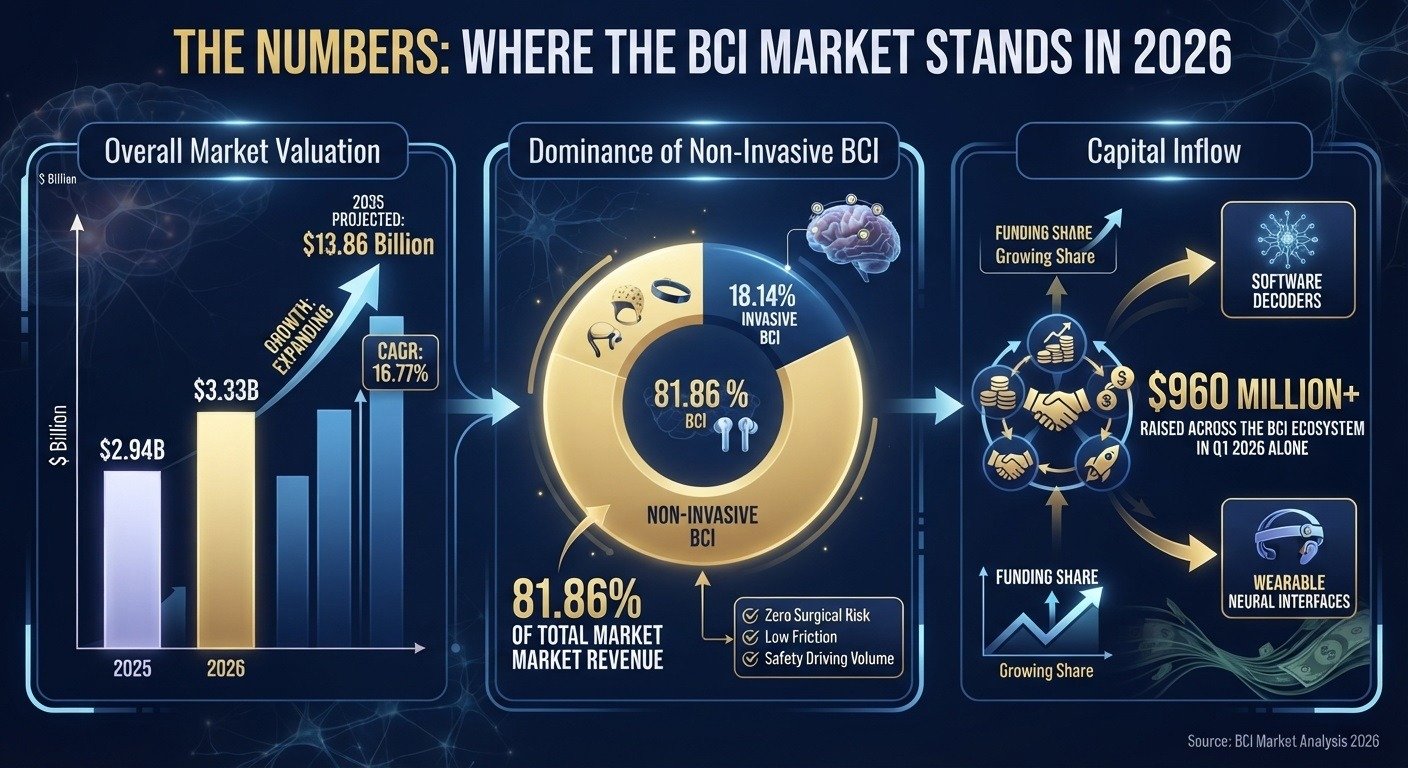
- Overall market valuation: The global BCI market expanded from $2.94 billion in 2025 to $3.33 billion in 2026, projected to reach $13.86 billion by 2035 at a 16.77% CAGR.
- Dominance of non-invasive BCI: Non-invasive devices (scalp-based EEG, headbands, smart audio) represent 81.86% of total market revenue, proving that safety, zero surgical risk, and low friction are driving near-term market volume.
- Capital inflow: Over $960 million was raised across the BCI ecosystem in Q1 2026 alone, with software decoders and wearable neural interfaces capturing a growing share of private venture funding.
| BCI market segment | 2025 base value | 2026 estimated | 2035 projection | CAGR (2026–2035) | Primary commercial drivers |
| Non-invasive (consumer & enterprise) | $2.41 Billion | $2.73 Billion | $11.35 Billion | 16.90% | Workplace productivity, mental wellness, neuro-gaming, accessible biofeedback |
| Implantable & semi-invasive (clinical) | $0.53 Billion | $0.60 Billion | $2.51 Billion | 15.80% | Paralysis restoration, neurodegenerative treatment, FDA Breakthrough trials |
| Total global market | $2.94 Billion | $3.33 Billion | $13.86 Billion | 16.77% | Cross-industry adoption, AI signal decoding, consumer electronics integration |
Key Players
Mapping the BCI ecosystem
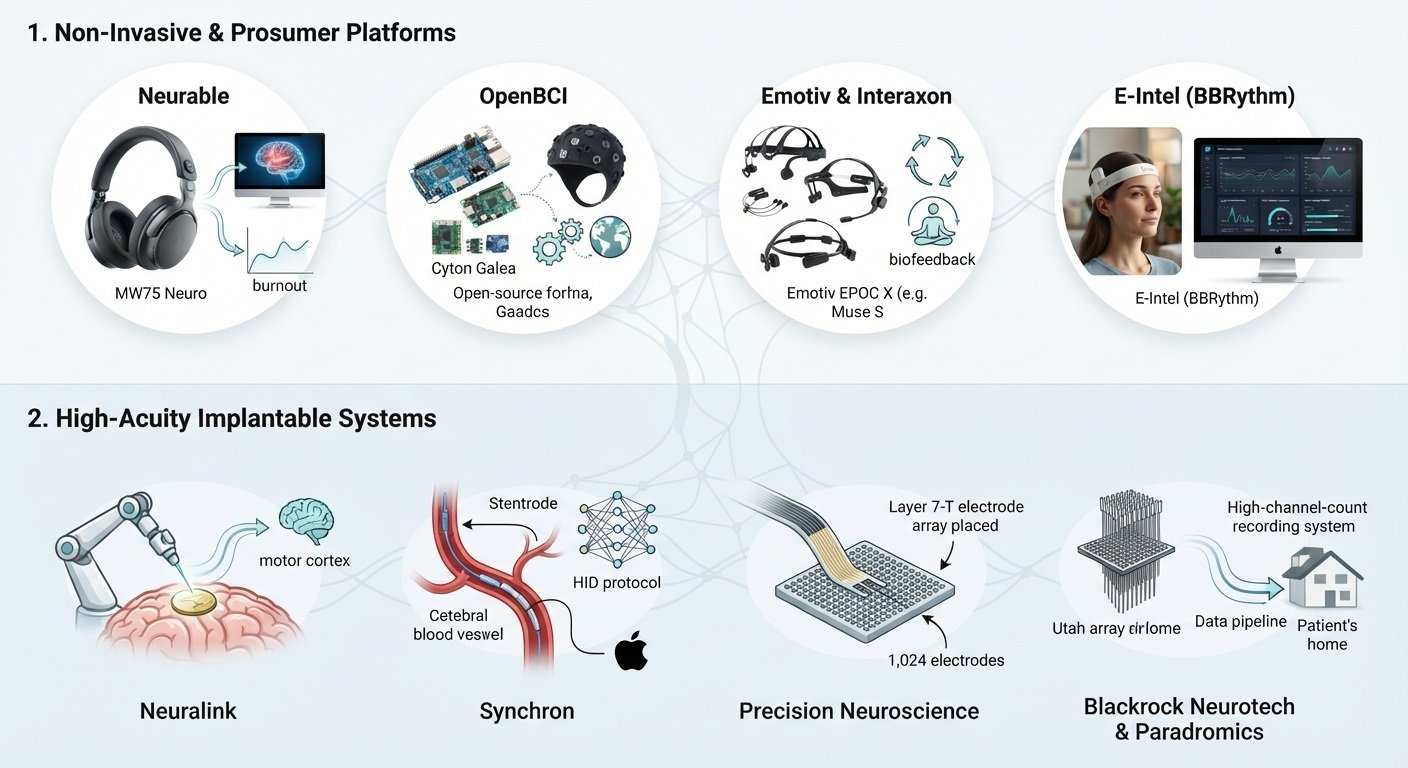
1. Non-invasive & prosumer platforms (commercial volume Leaders)
- Neurable: Pioneer in consumer-grade smart headphone integration (MW75 Neuro), delivering continuous focus tracking and burnout prevention algorithms directly into everyday consumer audio hardware.
- E-Intel (BBRythm): Advanced digital neurofeedback platform leveraging accessible, multi-channel EEG headbands (e.g., Muse 2 ecosystem) for real-time cognitive optimization, stress mitigation, and personal neuro-training.
- OpenBCI: Open-source research and development hardware platform democratizing neural sensing for software developers, university labs, and enterprise innovation teams globally.
- Emotiv & interaxon (Muse): Industry standard-bearers in consumer biofeedback and portable EEG hardware, powering consumer wellness and cognitive research applications.
2. High-acuity implantable systems (clinical benchmarks)
- Neuralink: High-profile direct cortical interface utilizing automated surgical robotics; expanding human trial cohorts in 2025–2026 targeting severe motor impairment.
- Synchron: Minimally invasive endovascular Stentrode system inserted via blood vessels (no craniotomy required). Pioneer in native Apple BCI HID protocol integration.
- Precision neuroscience: Developer of the FDA 510(k)-cleared Layer 7-T Cortical Interface, a high-density, 1,024-electrode flexible array engineered for micro-slit surgical placement.
- Blackrock neurotech & paradromics: Decades of Utah array research heritage now expanding into home-use clinical trials and high-channel-count cortical recording systems.
Geographic Landscape
The three core markets
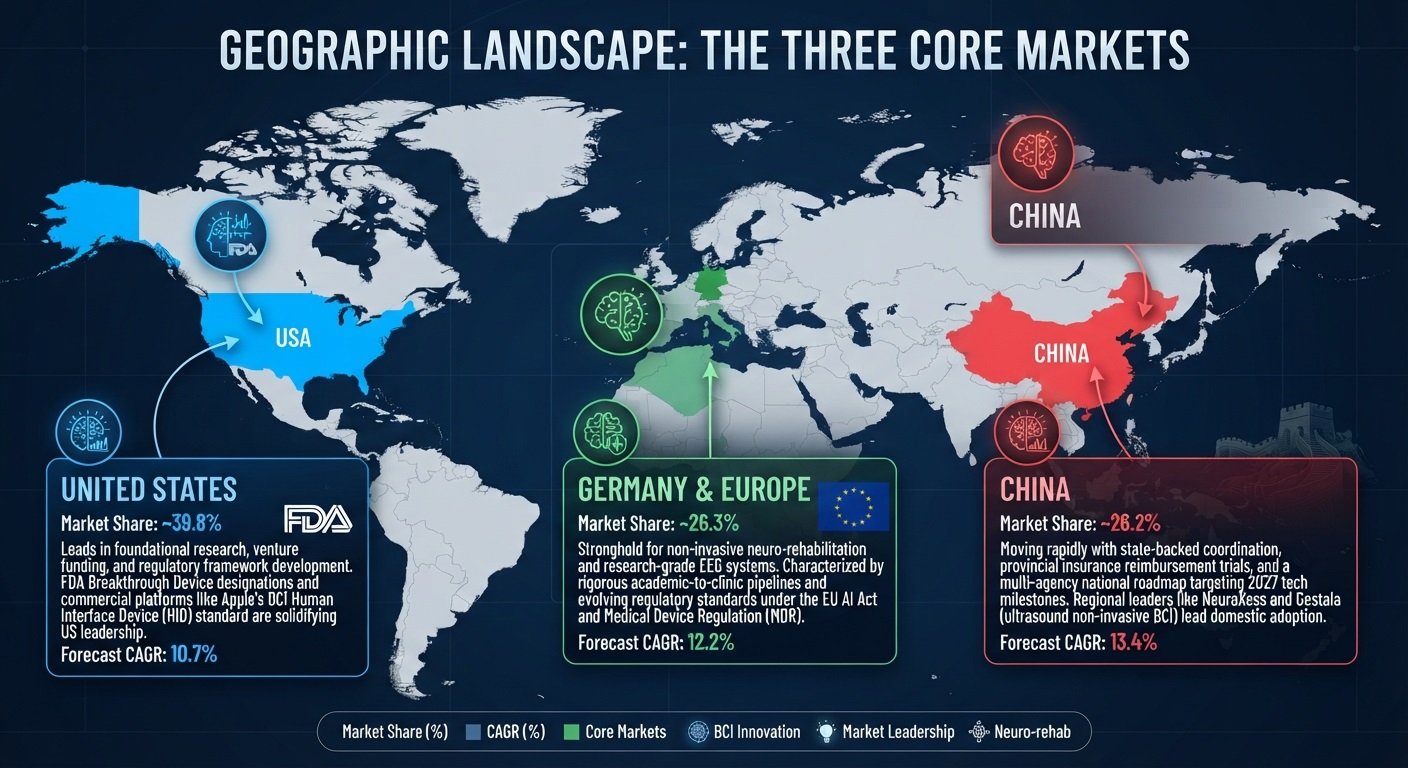
- United States (market share: ~39.8%): Leads in foundational research, venture funding, and regulatory framework development. FDA Breakthrough Device designations and commercial platforms like Apple’s BCI Human Interface Device (HID) standard are solidifying US leadership. Forecast CAGR: 10.7%.
- China (market share: ~26.2%): Moving rapidly with state-backed coordination, provincial insurance reimbursement trials, and a multi-agency national roadmap targeting 2027 tech milestones. Regional leaders like NeuroXess and Gestala (ultrasound non-invasive BCI) lead domestic adoption. Forecast CAGR: 13.4%.
- Germany & Europe (market share: ~26.3%): Stronghold for non-invasive neuro-rehabilitation and research-grade EEG systems. Characterized by rigorous academic-to-clinic pipelines and evolving regulatory standards under the EU AI Act and Medical Device Regulation (MDR). Forecast CAGR: 12.2%.
The Non-Clinical Turn
BCIs beyond the hospital
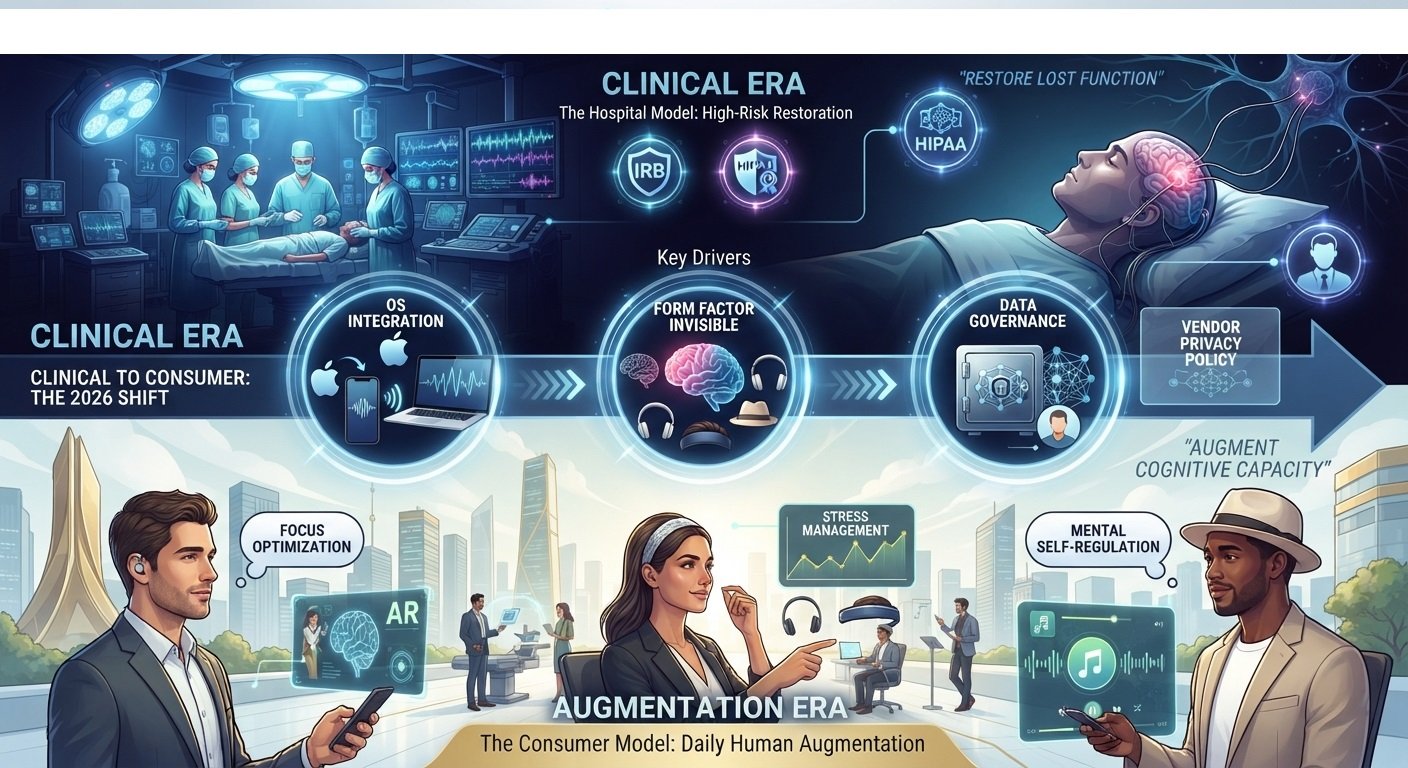
For decades, neural interfaces were restricted to high-risk clinical trials in specialized hospital settings. In 2026, the center of gravity is shifting toward daily human augmentation.
“The BCI market is no longer solely defined by restoring lost physiological function. It is rapidly expanding into augmenting cognitive capacity—optimizing focus, managing stress, and democratizing mental self-regulation. That fundamental shift changes the business model, the target user, and the ethical responsibility.”
Key drivers of commercial expansion:
- Operating system integration: Apple’s inclusion of native BCI HID protocols allows neural devices to control consumer electronics natively without custom software wrappers.
- Form factor invisible technology: BCI sensors are transitioning into everyday wearables—headphones, smart headbands, and light hats—making continuous neural sensing socially frictionless.
- Data governance & privacy: While hospital implants are strictly governed by IRB and HIPAA protocols, consumer neural data collected via prosumer devices relies on vendor privacy policies. Establishing robust, transparent neural data protections is becoming a core commercial differentiator.
Investment Trends
Follow the capital in 2026
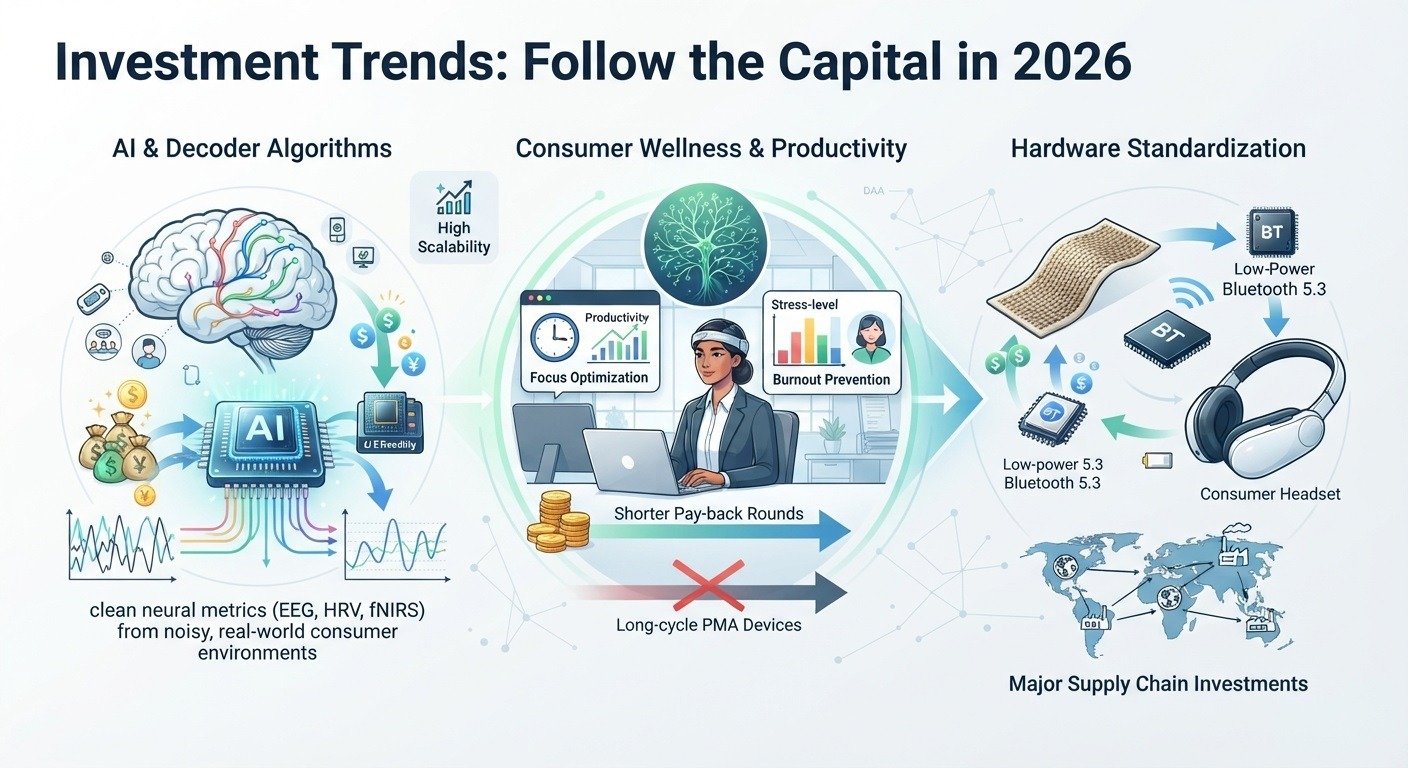
Venture capital allocation in 2026 reflects a distinct pivot toward scalability and software intelligence:
- AI & decoder algorithms: Capital is flowing heavily into signal-processing platforms that can isolate clean neural metrics (EEG, HRV, fNIRS) from noisy, real-world consumer environments.
- Consumer wellness & productivity: Non-invasive platforms targeting enterprise wellness, burnout prevention, and focus optimization are attracting shorter pay-back venture rounds compared to long-cycle clinical PMA devices.
- Hardware standardization: Component miniaturization, low-power Bluetooth 5.2/5.3 chips, and flexible fabric sensors are receiving major supply chain investments.
E-Intel perspective: The non-invasive imperative
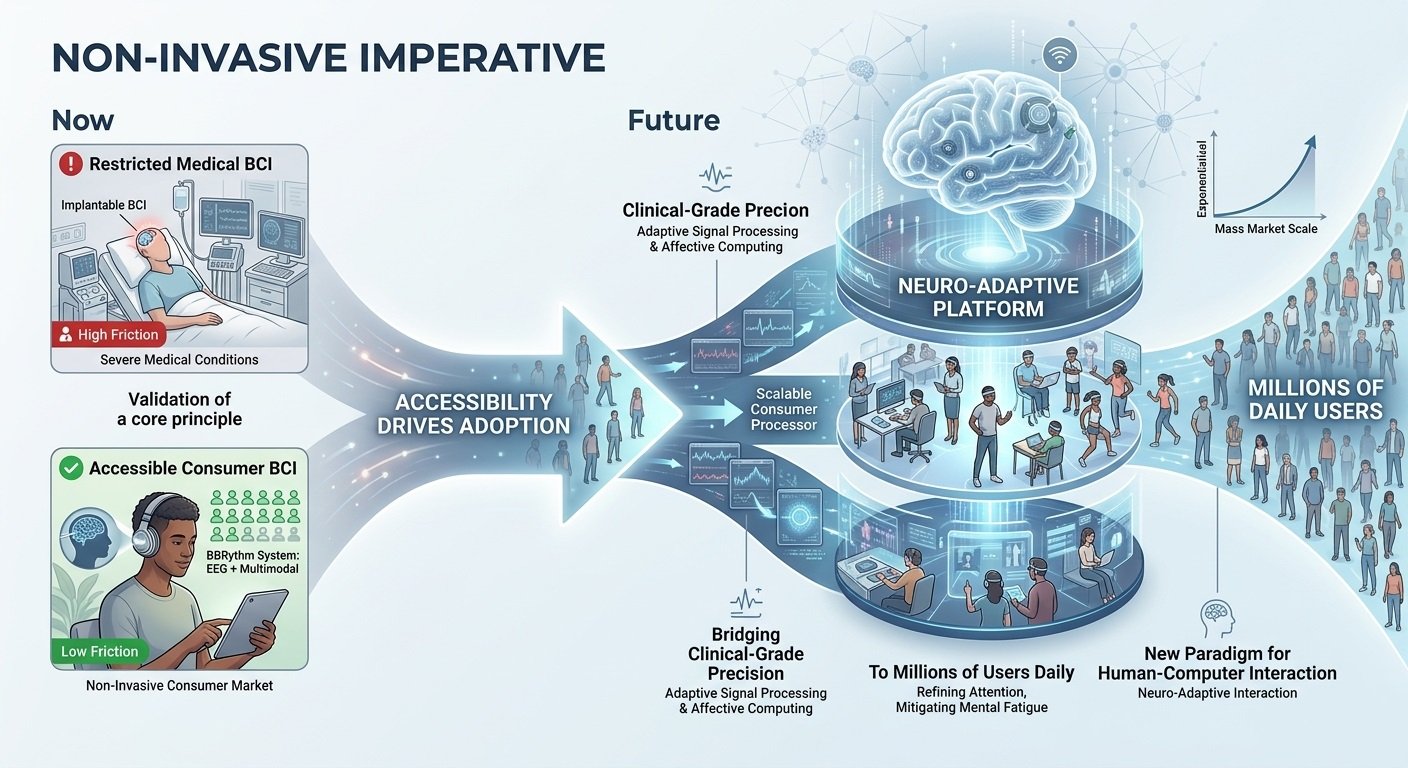
At E-Intel, we view the current market transition as validation of a core principle: accessibility drives adoption.
While high-channel implantable BCIs remain vital for severe medical conditions, the mass-market future of neurotechnology belongs to non-invasive, low-friction, multi-modal systems. Platforms like BBRythm demonstrate that consumer-grade EEG hardware—combined with adaptive signal processing and affective computing—can deliver real-time, actionable neurofeedback without surgical intervention or prohibitive costs.
By bridging consumer wearables with clinical-grade analytical precision, the industry can bring neuro-adaptive technology to millions of users daily—refining attention, mitigating mental fatigue, and establishing a new paradigm for human-computer interaction.
At E-Intel, we view the current market transition as validation of a core principle: accessibility drives adoption.
While high-channel implantable BCIs remain vital for severe medical conditions, the mass-market future of neurotechnology belongs to non-invasive, low-friction, multi-modal systems. Platforms like BBRythm demonstrate that consumer-grade EEG hardware—combined with adaptive signal processing and affective computing—can deliver real-time, actionable neurofeedback without surgical intervention or prohibitive costs.
By bridging consumer wearables with clinical-grade analytical precision, the industry can bring neuro-adaptive technology to millions of users daily—refining attention, mitigating mental fatigue, and establishing a new paradigm for human-computer interaction.
References
- CGTN. (2026, April 2). Brain-computer interface tech advances from R&D to clinical trials. CGTN Technology. https://news.cgtn.com/news/2026-04-02/Brain-computer-interface-tech-advances-from-R-D-to-clinical-trials-1LZHZapY5rO/index.html
- Dataintelo. (2026, April). Brain-Computer Interface Market Research Report 2025–2034. Dataintelo Industry Analysis. https://dataintelo.com/report/brain-computer-interface-market
- MedTech Dive. (2025, April 21). Precision Neuroscience receives FDA clearance for brain implant. MedTech Dive. https://www.medtechdive.com/news/precision-neuroscience-brain-implant-fda-cleared/745913/
- Neurable Inc. (2024, September 24). Neurable Inc. launches first smart brain-computer interface-enabled headphones for consumer market. Business Wire. https://www.businesswire.com/news/home/20240924893354/en/
- Precedence Research. (2026, September). Brain Computer Interface Market Size, Share & Trends Analysis Report 2026–2035. Precedence Research. https://www.precedenceresearch.com/brain-computer-interface-market